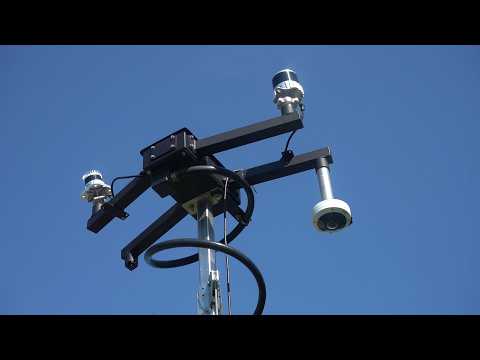
This research enhances transportation safety through large-scale deployment of intelligent video analysis and artificial intelligence techniques for real-time infrastructure monitoring, building on two years of previous development. The Year 3 initiative expands the proven framework beyond bridges to include urban infrastructure including traffic signals, light poles, pedestrian bridges, and other structural components essential for safe transportation operations. The methodology leverages existing surveillance infrastructure to capture displacement and vibration signals through computer vision techniques including feature tracking, optical flow, and motion magnification, eliminating the need for extensive physical instrumentation. Advanced signal processing methods integrate with video analytics to quantify dynamic behavior and detect structural changes over time. Inverse modeling algorithms estimate key structural parameters including stiffness, mass distribution, and damage locations from measured displacement histories. The research develops an AI-based decision support system combining analysis results with predictive capabilities to help agencies prioritize maintenance work based on risk assessment and structural condition evaluation. A pilot program implementation with District of Columbia Department of Transportation demonstrates real-world applicability in urban settings, serving as a platform for practical validation and stakeholder engagement.
Universities Involved
Howard University
Principal Investigators
Claudia Marin
Expected Research Outcomes & Impacts
The application of this research will transform transportation infrastructure monitoring by enabling agencies to transition from reactive maintenance to data-driven preventive strategies through real-time structural health assessment capabilities. Transportation agencies will gain enhanced abilities to detect anomalies and assess structural integrity without costly sensor network deployments, leveraging existing surveillance infrastructure for comprehensive monitoring. The District of Columbia Department of Transportation pilot implementation will demonstrate practical applicability and provide feedback on system performance, usability, and integration with existing agency processes. Transportation professionals will benefit from improved risk assessment tools enabling more informed maintenance prioritization decisions based on actual structural conditions rather than predetermined schedules. Long-term impacts include enhanced infrastructure safety through early detection of structural issues, reduced risks associated with structural failures, and more efficient resource allocation for maintenance activities. The scalable monitoring methodology will enable broader deployment across diverse transportation infrastructure types, supporting improved safety standards nationwide. Academic institutions will benefit from enhanced educational programs integrating artificial intelligence, data science, and infrastructure monitoring techniques into transportation engineering curricula. The interdisciplinary collaboration model will strengthen public-sector transportation agencies’ partnerships with academia, ensuring developed tools remain deployable and impactful in real-world applications. Communities will experience improved transportation infrastructure reliability and safety through proactive maintenance strategies enabled by continuous monitoring capabilities and data-driven decision- making processes.
Subject Areas
Artificial Intelligence, Safety, Traffic Management