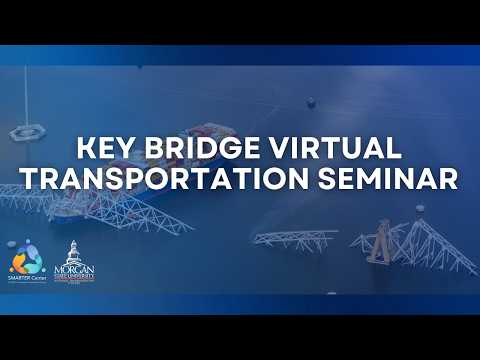
On March 26, 2024, the container ship Dali struck a support column of the Francis Scott Key Bridge in Baltimore, bringing down the main span and killing six workers. Within hours, one of the region’s most critical transportation links was gone.
The collapse cut off a route that more than 30,000 vehicles used every day. Commuters, freight haulers, and hazmat carriers all lost their primary path across the Patapsco River. The Port of Baltimore, one of the nation’s busiest for vehicle imports and roll-on/roll-off cargo, was temporarily shut to large cargo vessel traffic. In the neighborhoods closest to the bridge, residents faced sudden, dramatic changes to the way they got to work, to school, and to each other.
The SMARTER Center launched this study to understand what happened to the region’s roadways, freight economy, commutes, and communities. The goal is to produce evidence that agencies, planners, and policymakers can act on, both during the ongoing reconstruction and in preparing for future infrastructure failures.
What We're Studying
This project spans traffic engineering, travel behavior, structural health, logistics, environmental science, and community engagement. Each research area tackles a different dimension of the collapse’s impact, but they share a common thread: pairing rigorous data with the lived experiences of the people and industries affected.
The study is organized into several interconnected research areas. Select one below to explore what we’ve found so far.
Across all five research areas, a set of consistent themes is emerging. Detailed findings live on each research page. Here’s a snapshot of where the evidence points so far.
Tunnels became the pressure point. After the collapse, the I-95 and I-895 tunnel approaches absorbed the bulk of rerouted traffic. Speeds on those segments dropped by roughly two-thirds during peak hours, with queues stretching 8–9 miles upstream.
Evening congestion has been the hardest to fix. Morning travel partially recovered as some commuters shifted schedules or adopted telework, but PM delays remain severe — even a full year later — because evening trips mix commuting with errands, childcare, and social travel that people can’t easily reschedule.
The burden falls unevenly. Nearly two-thirds of trips through the worst bottleneck in the morning peak start or end in census tracts designated as disadvantaged. Lower-income residents, hourly workers, and single-car households have the fewest options to adapt.
People are adjusting, but at a cost. About 40% of survey respondents now leave home earlier for work. More than 53% report higher travel expenses. Roughly 32% say they’re now reluctant to live or work near large bridges — a sign of lasting psychological impact.
Port and supply chain effects rippled nationally. Container volumes, auto exports, and roll-on/roll-off tonnage all dropped sharply after the collapse. Recovery has been strong — Seagirt Marine Terminal hit record truck volumes by early 2025 — but the episode exposed how a single infrastructure failure can simultaneously disrupt road freight and maritime trade.
Bridge risk extends beyond natural hazards. The research shows that some bridges carry higher human-induced risk than their original design assumed, especially where vessel traffic has grown. A small number of asset–threat pairs tend to dominate overall risk, making targeted protection investments highly effective.
"We met with a resident from Edgemere who now takes 40 to 50 minutes to visit her sick mother on the west side of Baltimore, compared to the 20 minutes it took before the bridge collapse. This type of information is crucial for our database to formulate recommendations for MDOT or other agencies to mitigate the negative impacts."
Di Yang
Co-Principal Investigator
Watch Our 2 Year Anniversary Seminar
On March 27, 2026—the second anniversary of the Francis Scott Key Bridge collapse—the National Transportation Center and SMARTER Center convened researchers, practitioners, and policymakers for a virtual seminar presenting findings from their ongoing research. The event featured a keynote address from MDTA Executive Director Bruce Gartner, a research panel on supply chain security and governance, presentations on traffic and behavioral analysis, and a conversation on traffic demand management and transit incentives featuring MDOT Assistant Secretary for Public Affairs and Strategy Jawauna Greene and Vinn White.
Funding & Acknowledgements
This research is supported by the National Science Foundation under Award No. 2427232 and by the U.S. Department of Transportation through the SMARTER University Transportation Center. The research team gratefully acknowledges the cooperation of the Maryland Department of Transportation, Commuter Choice Maryland, and the local community organizations that made the survey and outreach efforts possible.